How to Read Betting Markets: Lines, Totals, Handicaps
A betting market is a price list, not a prediction. The bookmaker publishes every outcome it is willing to take money on and attaches a number to each one. Your job is to decide whether one of those numbers pays more than the outcome is actually worth. Everything else in a betting guide is a detail hanging off that sentence.
Name the outcome before you look at the price
Before you read a single number, say out loud what you are backing. "The home team wins in ninety minutes" is one market. "The home team wins and both teams score" is a different market with a different price and a different risk. A large share of beginner losses comes from backing one thing while believing they backed another, usually because the label on the slip was read quickly and the rules were not read at all.
Every market answers three questions: which event, which outcome, and which condition voids or refunds the bet. The third question is the one people skip. A draw no bet market returns your stake when the match ends level. A whole number handicap pushes when the margin lands exactly on the number. Those conditions are not fine print, they are part of what you are paying for.
The 1X2 family and the overround
1X2 is the plain three-way market on a football match: home win, draw, away win. Convert each price to an implied probability by dividing one by the decimal odds, then add the three results together. A fair market would total 100 percent. A real market totals more, and the difference is the bookmaker's margin, usually called the overround.
If the three prices imply 105 percent, the extra five points are the book's theoretical profit and your theoretical cost. Sharp books on major leagues often sit near 102 percent. Smaller leagues, niche markets and low-limit accounts can drift well above that. The margin is not a scandal, it is the cost of the service, but a fair-looking price can still lose once the margin is counted.
The same structure appears elsewhere under different names. In American sports the three-way market usually becomes a two-way moneyline, because a draw is either impossible or settled by overtime. The arithmetic does not change: convert each price, add the implied probabilities, and compare the total against the fair 100 percent.
Totals: the line carries the risk
A totals market asks whether the combined score will finish above or below a number set by the book. The number is the interesting part, not the price. A total of 2.5 goals cannot push, because half a goal does not exist. A total of 3.0 can push, and when it does your stake comes back untouched. That is why the price on a whole number is usually worse than the price on the half lines either side of it: you are paying for insurance against the exact landing point.
Compare the line first and the price second. Over 2.5 at 1.95 and over 3.0 at 2.05 are not the same bet, and treating the bigger number as the better price is one of the most common errors in the whole market.
Handicaps, spreads and the direction of the sign
A handicap gives one side a head start or a deficit so that both outcomes become roughly equally likely. In Asian handicap markets the quarter lines, 0.25 and 0.75, split your stake between two neighbouring lines, which is why a half win or a half loss can appear on the settlement. In American sports the same idea is called the spread, and the price on each side sits near even money because the line does the balancing work instead of the odds.
The key skill is reading the direction. A team at minus one and a half must win by two or more for the bet to land. A team at plus one and a half can lose by a single goal and still cover. The sign belongs to the team you are backing, not to your bet, and a minus in front of the opponent is not the same thing as a minus in front of your side.
A market table you can reuse
| Market | What you are backing | Push possible | Typical price shape |
|---|---|---|---|
| 1X2 | One of three results in ninety minutes | No | Favourite short, outsider long |
| Moneyline | One of two sides to win outright | No | Both sides often near even |
| Total, 2.5 line | Combined score above or below 2.5 | No | Close to even, moves on team news |
| Total, 3.0 line | Combined score above or below 3.0 | Yes, on exactly three | Worse than the half lines |
| Asian handicap, 0.25 | Side with a quarter goal start | Half stake only | Near even, stake is split |
| Draw no bet | Side to win, stake back on a draw | Yes, on a draw | Shorter than the 1X2 win price |
Why prices move during the day
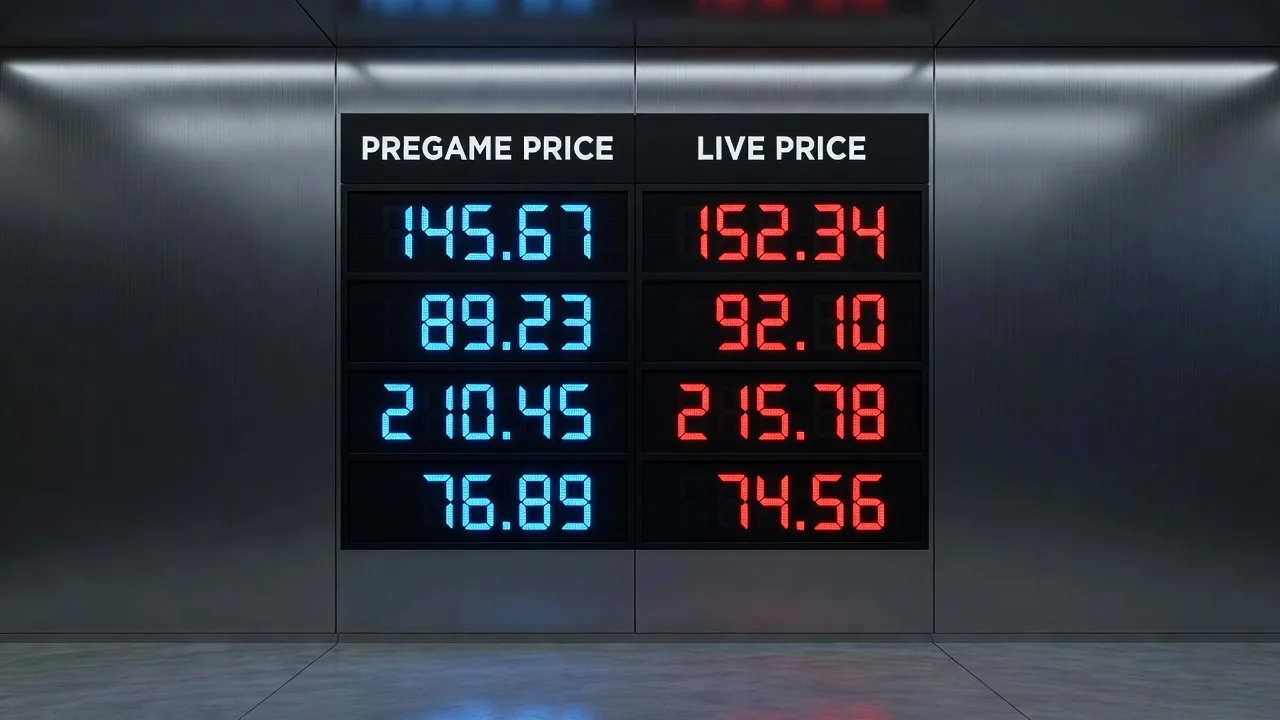
Prices move for two reasons: money arrives, or information arrives. Team news, weather, a late fitness test, a refereeing appointment, a suspension picked up in a cup match: each changes the fair price, and a book that is slow to adjust gets hit by anyone who saw the news first. When a line moves two hours before kickoff with no obvious story, the usual explanation is that a large or well-informed bettor took the other side.
This is why the closing price matters so much. The closing price is the market's last collective opinion, after all the information has been priced in. Comparing the price you took with the price at kickoff is the cleanest feedback a bettor can get, because it measures your decision against the final consensus rather than against the result. A separate guide on closing line value walks through that calculation step by step.
A five minute routine for any market
- Write the outcome in one sentence, including the condition that voids the bet.
- Convert every price in the market to an implied probability and add them up.
- Check whether the line is whole, half or quarter, and note whether a push is possible.
- Compare the same market at two or three books before you commit.
- Record the price you took and the time you took it, because you will need both later.
Misreads that cost money
The most expensive misread is treating a boosted price as a better bet. A boost is a marketing offer, not a valuation. If the underlying price is short, a boost from 1.50 to 1.60 is still a short price. The second most expensive misread is comparing prices across different lines, which happens constantly with totals and handicaps. The third is ignoring the settlement rule on a market with a push, then feeling cheated when the stake simply comes back.
None of these are exotic. They are ordinary mistakes made by people who understand the sport well and the market poorly. The market is a separate skill, and it is learned the same way as any other: by reading the price list carefully, one line at a time. If the odds formats themselves are still unfamiliar, start with the guide to reading betting odds before coming back to the markets.